






LAGOS AUGUST 27TH (NEWSRANGERS)-More than 160 people have been killed after a glacial collapse triggered catastrophic flash floods across northern Nepal and Tibet, with rescue teams searching for hundreds more, including Americans, who remain missing.
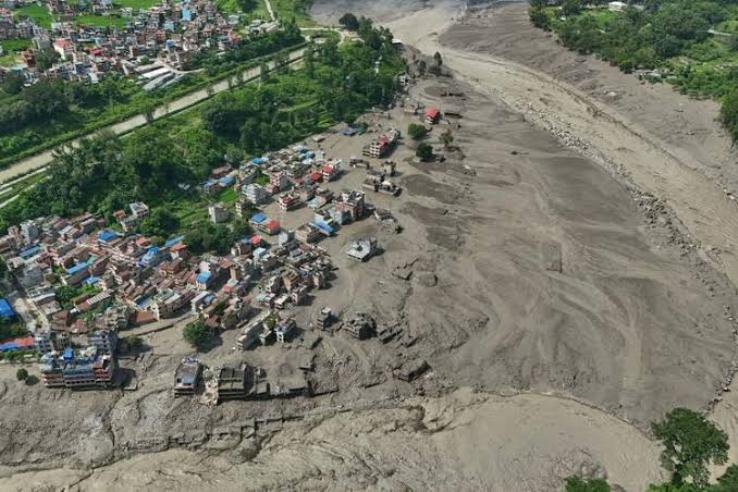
A towering surge of muddy water roared through the Himalayan border crossing at Gyirong Port on Wednesday. Surveillance footage from the Resuo Bridge captured people running for safety as a brown torrent of mud, rock and water barrels down the canyon from the Nepalese side of the border, swallowing buildings at the port.
Police in Nepal reported at least 162 deaths, while China’s Xinhua News Agency said three people were killed and nearly 560 remained missing in Tibet.
Officials in Nepal earlier said about 340 foreigners were reported missing, including Americans. Tourism officials said 133 of those missing were Indian pilgrims traveling to Mount Kailash in Tibet. The missing also included 47 Americans, 34 Australians, 33 Britons and 24 Canadians.
The State Department said it was aware of Americans affected by the disaster.
In a post to X on Wednesday, Secretary of State Marco Rubio said, “We express our solidarity and are united in prayer for the Nepali people following the devastating floods. @StateDept stands ready to support the Government of Nepal with needed humanitarian assistance.”
The U.S. Department of State Consular Affairs said on X Wednesday night, “Americans in areas affected by the recent flash flooding in Nepal should follow the latest guidance from the U.S. Department of State and the U.S. Embassy in Kathmandu. @StateDept is assisting Americans 24/7 at +1-202-501-4444. Family and friends in the United States who are concerned about American loved ones in Nepal can call us toll free at +1-888-407-4747.”
Newsweek has contacted the U.S. embassy in Nepal and the U.S. State Department for comment.
The disaster began when an avalanche of ice and rock blocked a river before unleashing a sudden surge downstream, according to officials and climate experts cited by The Associated Press. The flooding tore through villages, roads and hydropower projects in Nepal’s Rasuwa district before reaching the Chinese side of the border.
“We have asked both India and China to help us with the rescue efforts,” Sasmit Pokharel, a spokesperson for the Nepalese government, told the AP.
Nepal asked neighboring India and China to assist with rescue efforts as authorities worked to reach the affected areas.
Rasuwa district experienced similar flooding in August 2025, when a glacial lake in neighboring Tibet overflowed amid high temperatures in the mountain region. Nine people were killed and critical infrastructure, including a bridge connecting Nepal and China, was damaged.
What Triggered the Flash Flood?
An avalanche of ice and rock from a glacier on the Nepalese side of the border likely blocked the Lhende Khola River before releasing a sudden surge downstream, according to climate experts at the International Centre for Integrated Mountain Development.
“The Lhende Khola has flooded twice in 14 months, this time triggered by an ice rock avalanche from a glacier on the Nepal side that blocked the river and released a sudden surge downstream,” Saswata Sanyal, a disaster risk reduction specialist at the organization, said.
Sanyal said the disaster underlined the growing need for warning systems in a region increasingly exposed to climate-related hazards.
“In a warming Himalaya, early warning is the first line of adaptation,” he added.
The Himalayan region is particularly vulnerable to floods, landslides and heavy rainfall because it is warming faster than the rest of the world due to human-caused climate change. Research by the Kathmandu-based organization found that the rate of glacier ice loss across the Hindu Kush Himalaya has doubled since 2000, primarily because of rising global temperatures.
China’s Response to Flash Flood
Chinese President Xi Jinping ordered “all-out efforts” to find people missing after the mudslide caused casualties at Gyirong Port, according to China’s state-run Xinhua News Agency.
Xi called for residents at risk to be evacuated and injured people to receive timely medical treatment. He also instructed officials to strengthen monitoring and early-warning systems, conduct rescue operations carefully and guard against secondary disasters.
Chinese Premier Li Qiang ordered authorities to verify the number of missing and affected people and directed the Foreign Ministry to coordinate with other countries and share information. Vice Premier Zhang Guoqing traveled to the affected area to oversee rescue and disaster-response operations, Xinhua reported.
A total of 145 officers and soldiers from the Xigaze detachment of the People’s Armed Police were dispatched to Gyirong Port, according to the state-run Global Times, which cited the force’s Xizang Corps. The outlet reported that drone footage showed buildings at the port buried by debris.
China’s Ministry of Finance and Ministry of Emergency Management allocated 120 million yuan, about $17.9 million, to support rescue and relief operations following the disaster, state broadcaster CGTN reported.
This article contains reporting by the Associated Press.
NewsWeek
For advertisement placement, events coverage, media consultancy, placement of pubications and further enquiries please WhatsApp 2348023773039 or email: labakevwe@yahoo.com