







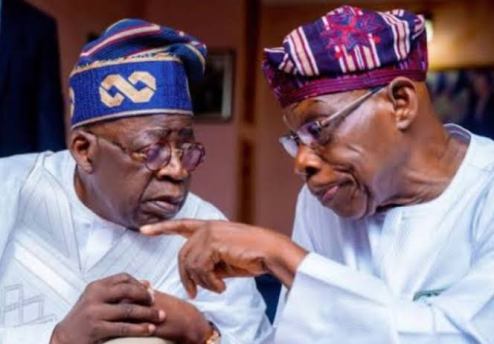
LAGOS OCTOBER 31ST (NEWSRANGERS)-Former President Olusegun Obasanjo has criticised President Bola Tinubu over his administration’s position on borrowing, insisting that Nigeria’s growing debt burden poses a greater danger to the country than leprosy.
Obasanjo said excessive borrowing does not only affect the government in power but also places a financial burden on future generations.
He argued that while leprosy affects an individual, the consequences of mounting national debt could extend to generations of Nigerians who had no part in accumulating the loans.
The former president made the remarks on Friday at the third Ajibosin Annual Symposium held at the amphitheatre of the Olusegun Obasanjo Presidential Library in Abeokuta, Ogun State.
The symposium was organised around the theme, “Leveraging Artificial Intelligence to Solve Grassroots Problems and Accelerate National Development”.
His comments followed Tinubu’s recent remarks that borrowing should not be treated as leprosy, as he maintained that taking loans was not necessarily harmful if the government worked hard to repay them.
However, Obasanjo rejected the argument and questioned the justification for Nigeria’s continued dependence on borrowing despite the country’s economic challenges.
According to him, the problem is not simply the decision to obtain loans but the long-term consequences of accumulating debts without sufficient consideration for the country’s ability to repay them.
The former president, who governed Nigeria between 1999 and 2007, recalled the debt relief secured by his administration through negotiations with the Paris Club.
The agreement resulted in the cancellation of about $30 billion of Nigeria’s external debt.
Obasanjo suggested that the country should be more cautious about returning to a situation where a significant portion of its resources is committed to servicing debts.
He also criticised the influence of international financial institutions, particularly the World Bank and the International Monetary Fund, on Nigeria’s economic policies.
The former president argued that policies promoted by the institutions were not necessarily designed around the needs and development priorities of African countries.
Obasanjo supported his criticism with an account of agricultural subsidies in Britain. He recalled a meeting with former British Prime Minister James Callaghan, during which he learnt that farmers received government support for every sheep they owned.
He questioned why Nigeria was discouraged from supporting its agricultural sector when developed countries continued to provide assistance to their farmers.
He said, “I was sitting with the former Prime Minister of Britain, Jimmy Callaghan. Callaghan was a sheep farmer. He was being paid four euros per annum on every sheep he owned, and they say we must never subsidise agriculture, and if we subsidise agriculture, we won’t get money from the World Bank or from the IMF.”
The former president maintained that Nigeria should not allow international financial institutions to dictate policies without considering the country’s peculiar economic circumstances.
He argued that although officials working with the World Bank and IMF might possess strong academic qualifications, their recommendations should not automatically become the country’s economic direction.
Obasanjo questioned why Nigeria should depend on policy prescriptions from people who might not fully understand the country’s social and economic realities.
He said, “World Bank and IMF were not designed for us. They were built before we became independent, and that’s the people who will determine what we do. They are brilliant boys and girls; they went to Ivy League universities, Oxford, Cambridge, and all that. My children went to some of them, including Iyabo. She went to one of those schools; she went to Cornell.
“How can Iyabo be the one who will tell me how I will run my home? These brilliant boys will package everything very well academically. They tell us, and we take it, lock, stock, and barrel, and we use it. For a country of 250 million people, it is boys and girls who are not even married, let alone manage a home, who will tell us what we will do to manage our people, our country, and we swallow it, and we destroy ourselves.”
Obasanjo also expressed concern over the declining value of the naira, using his personal experience in agriculture to illustrate the extent of the currency’s depreciation.
He recalled that when he established his farm about 47 years ago, the exchange rate stood at approximately N1 to $1.85.
He questioned how the country had arrived at an exchange rate of about N1,500 to the dollar.
He said, “When I started my farm 47 years ago, one naira to the dollar was one naira to one dollar 85 cents. What has Nigeria done in 47 years that we now have N1,500 naira to the dollar? What have we done?
“What do our leaders know, and what do they not know? From what they know, what can they do for us? For anybody to say debt is no leprosy is absolute nonsense. Debt is worse than leprosy, because leprosy destroys only one person. Debt destroys generations.”
Politics Nigeria earlier reported that the President recently sought legislative approval for a supplementary external borrowing plan involving $20.52 billion and €1.045 billion to finance projects and programmes across different sectors.
The proposed financing covers areas including power, transportation, healthcare, education, agriculture, water supply, security and job creation.
The government has maintained that the funds would support investments expected to improve infrastructure and economic activities.
Beyond the debt controversy, Obasanjo also used the symposium to raise concerns about Nigeria’s readiness to embrace artificial intelligence and other emerging technologies.
He warned that African countries could expose themselves to new forms of exploitation if they adopted foreign technologies without developing the capacity to control them.
According to him, technology should not simply be imported and used without understanding the interests behind its development, ownership and deployment.
The former president acknowledged that he did not possess extensive technical knowledge of artificial intelligence but maintained that control over technology was essential to preventing its misuse.
He said, “I don’t know too much technically about AI. But I know that anything that is not in your control can be abused against you.”
The concerns were also raised by Dr Umar Ardo, a historian and political commentator who delivered a lecture at the event.
He warned that Africa could face another phase of economic exploitation through artificial intelligence if countries on the continent failed to establish control over their data, technological infrastructure and intellectual property.
Ardo acknowledged the opportunities presented by AI but argued that the continent must avoid repeating the mistakes of previous generations, when foreign powers controlled the technologies used to exploit Africa’s resources.
He traced the history of economic exploitation on the continent, beginning with the transatlantic slave trade, when millions of Africans were transported across the Atlantic to provide labour for foreign economies.
He said, “For over three centuries, Africa’s principal export was human beings. The transatlantic slave trade carried roughly twelve million Africans across the ocean. The technology of that era — sailing ships, navigational compasses, and firearms that enabled this trade — was not ours. We did not build the ships, set the prices or write the ledgers, though our men, women and children filled the cargoes.
“The most sophisticated technologies of the age were harnessed by others to extract what they valued most: human labour.”
Ardo explained that the pattern continued during colonial rule, when African countries became major sources of raw materials for industries in Europe and other parts of the world.
He noted that foreign powers controlled the infrastructure, machinery and commercial systems used to extract resources, while African countries supplied the labour and materials.
According to him, the situation did not change significantly after independence, as many African economies continued to depend on exporting unprocessed commodities while importing finished products.
He cited Nigeria’s continued dependence on crude oil exports and imported refined petroleum products as an example of the imbalance.
He also mentioned cocoa-producing countries that still depend heavily on foreign manufacturers for processed chocolate products.
Ardo said, “Stand back and see the arc: human beings, raw materials, unprocessed commodities and skilled labour. In every age, Africa has been the quarry and not the miner, the farm and not the factory, the source and not the beneficiary. We were repeatedly assured that each new arrangement was different, fair and mutually beneficial.
“Now comes the age of artificial intelligence, which Africa is urged to ‘leverage’. I do not dispute its arrival or its potential. I ask whether we have considered the terms of participation. Data may become the fourth commodity in this long history of extraction.
“Data generated by our people, farms, hospitals, languages, businesses and public institutions is increasingly valuable, yet computing infrastructure, models, intellectual property and profits remain concentrated elsewhere.”
He maintained that African countries must move beyond being consumers of foreign technology and invest in local research, innovation and technological infrastructure.
PoliticsNigeria
For advertisement placement, events coverge, media consultancy, placement of publications and further enquiries please WhatsApp 2348023773039 or email: labakevwe@yahoo.com