









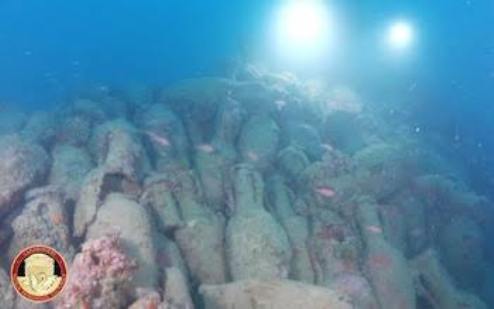
LAGOS AUGUST 11TH (NEWSRANGERS)-Divers have discovered the wreck of an ancient Roman ship, crammed with hundreds of ceramic jars, off the coast of Sicily.
The 2,000-year-old wreck, which lies at a depth of 46m (150ft), also contains a pair of lead anchors.
The ship, which dates back to the second or first century BC, was carrying jars full of wine and possibly oil when it was wrecked, presumably in a storm.
“This is one of the most important underwater archaeological discoveries of recent years,” said Alessandro Giuli, Italy’s culture minister.
“The sea continues to reveal precious fragments of our history. The wreck helps us understand the men, the trade routes and the exchange of goods that made the Mediterranean a crossroads of civilisations.”
It was discovered three miles off the coast of Mazara del Vallo, a town on the west coast of Sicily, by Giacomo De Mola, a freediver and fisherman.
“This is without doubt the most amazing discovery of my life,” he said on social media. “At a certain point the monitor of the echo sounder showed that there was a structure down there.
“I saw a dark shape and at that moment, time stood still. Beneath me was a huge expanse of amphorae [ancient ceramic jars], hundreds of them, all perfectly intact. And a Roman ship that has been resting there for more than 2,000 years.
“You realise that you are the first human to see this place in 20 centuries. A treasure on the seabed. A piece of history that has remained hidden amid the silence of the sea. The ocean never ceases to surprise us.”
Specialist divers with the police are to explore the site – Carabinieri via AFP
After the discovery, a team of specialist divers from the police was sent to explore the site. Marine archaeologists are expected to dive to study the wreck.
Most of the amphorae have been identified as a type known to archaeologists as Dressel 1A. They are tall, with sloping shoulders and long handles and were mostly used to transport wine around the Mediterranean.
In 2024, an ancient Roman battering ram from a naval battle in which Rome defeated Carthage was recovered from the sea off the coast of western Sicily.
The 3rd-century BC bronze ram, which was put on the bow of warships to rip into enemy vessels, was found at a depth of 260ft off the archipelago of the Egadi Islands.
The Battle of the Aegates, in 241BC, was the final naval clash between the fleets of Carthage and the Roman Republic during the First Punic War.
It marked a crucial turning point. Carthage, located near Tunis in modern-day Tunisia, went into decline after its defeat.
In 2023, divers found the wreckage of another ancient Roman vessel off the port of Civitavecchia, about 50 miles north of Rome. It was also laden with hundreds of amphorae.
The Telegraph
For advertisement placement, events coverage, media consultancy, placement of publications and further enquiries please WhatsApp 2348023773039 or email: labakevwe@yahoo.com