







LAGOS AUGUST 19TH (NEWSRANGERS)-A 4.9 magnitude earthquake struck southern Spain on Tuesday, injuring three people and forcing hotels to be evacuated.
The tremor sent debris falling from buildings in Granada in Spain’s Andalusia region days after a slightly stronger quake had hit the southern Spanish city.
The Alhambra Palace, a Unesco-listed jewel of medieval Islamic architecture and a huge draw for tourists, was partially evacuated.
The quake happened at around 10.38am local time. Its epicentre was in Alhendin, a town six miles south of Granada, according to the National Geographical Institute.
Three people were slightly injured, including a girl who was taken to hospital, Antonio Sanz, an emergencies official in the Andalusia region, said.
“Things have fallen over – flowerpots, pictures, figurines. I didn’t know how to react,” said Esther Sanz, a Granada resident who was at home when the quake struck. I didn’t know whether to stay or to go, but I thought the best thing to do was to take my cat Kelpie and head to Valencia.”
Alfonso Malpica, who lives in a ground floor flat, said: “It has been a torture. You really felt this.”
Hotels in the region were evacuated, with television pictures showing tourists and staff gathered outside the buildings.
X/@EfectoCocuyo, @GeoTechWar
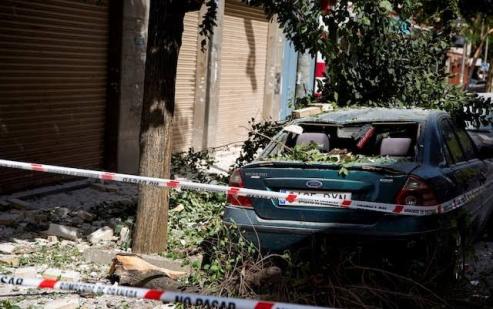
Some residential buildings suffered damage, with large cracks showing in the walls. Parts of some facades were dislodged, with bricks strewn across pavements and some damage to cars.
Emergency services said they had received more than 50 calls reporting cracks and falling debris, while officials warned of aftershocks.
Museums, sporting facilities and administrative buildings were closed, but health centres were kept open, Granada authorities said. The speed of trains on the city’s metro system was reduced to 30kph (19mph) as a precautionary measure.
“Everything came crashing down – it was terrifying,” Cristina Ruiz Lopez, a lab worker who was at a supermarket in Granada when the earthquake hit, wrote on social media.
The Alhambra’s Alcazaba, the historic fortress and oldest section of the complex, was evacuated after the quake. Access to the Nasrid Palaces was suspended, the site’s X account said.
It added that conservation teams, with support from experts from the University of Granada, were checking the complex. The Alhambra palace was the seat of Spain’s last Muslim kingdom.
The quake comes after a magnitude 5.0 earthquake woke residents in Granada shortly after 1am on Saturday.
No injuries were reported from that quake – possibly because there were less people in the streets at that hour – although there was damage to some buildings.
“Once again, an earthquake shakes Granada,” Juan Manuel Moreno, the head of the regional government, wrote on X, urging “maximum caution”.
He added: “Experts point out that it is possible for seismic movements and aftershocks to continue in the area. Let’s follow the advice and remain calm, please.”
The Iberian Peninsula is situated on the south-western edge of the Eurasian Plate and in the collision zone with the African Plate. Tectonic movement between the two plates accounts for much of the seismic activity in the Mediterranean.
This can cause low intensity earthquakes in parts of Andalusia, Murcia, Alicante and Valencia.
Furthermore, deadly 7.4-magnitude earthquake hit western Colombia last week, killing more than 280 people with hundreds more reported missing. The epicenter was located about three miles south of San José del Palmar, nearly 250 miles west of its capital of Bogotá.
Much of the devastation has been centered in Cali, the country’s third largest city with a population of 2 million, according to ABC News. The powerful quake, which struck last Monday morning, was felt around the country, including in Bogotá and Medellín, and reportedly even as far as Ecuador, Panama, and Venezuela, per The New York Times.
Following the deadly quake, a Save the Children staff member named Isabel said in a statement shared with Travel + Leisure her own Cali home was destroyed, leaving her feeling “powerless, frustrated, and very sad because the efforts of my entire family over many years vanished in a moment.”
“However, we have been staying strong by being together and facing the situation,” she added.
Rescuers have continued to sift through the debris, asking for silence as they listen for signs of life in the mounds of rubble, the Associated Press reported.
“Unfortunately, we are reaching a point where the probability of finding survivors is dwindling,” David Santiago Tamayo of the National Unit for Disaster Risk Management said on Thursday. “But the mission is to never stop searching and find all those reported missing.”
Following the earthquake, the U.S. Department of State said it mobilized “life-saving humanitarian assistance through trusted partners” and deployed a Disaster Assistance Response Team. Americans in Colombia can reach the State Department +1-202-501-4444 for assistance, while those concerned about American loved ones in Colombia can call +1-888-407-4747.
The State Department did not update its travel advisory for the country, however Canada and the United Kingdom are among countries that updated their travel alerts this week, specifically warning of disruptions, aftershocks, and travel disruptions in the wake of last week’s seismic activity.
The natural disaster comes weeks after neighboring Venezuela was struck by twin quakes, measuring 7.2 and 7.5 on the Richter scale.
How to Help Colombia’s Earthquake Victims
Much of the area ravaged by the disaster in Colombia already suffers from poverty and civil warfare. “This earthquake compounds an already severe humanitarian situation, and there is a need for increased support for the humanitarian response,” Giovanni Rizzo, the country director for the Norwegian Refugee Council in Colombia, said in a statement.
In an effort to help, Marc Anthony, Luis Fonsi, and Chayanne were among the artists to lead a live benefit concert and national telethon on Sunday in Miami. The Unidos por los Nuestros (United for Each Other) concert raised money for both the Colombia and Venezuela earthquake victims.
While many disaster relief efforts have been shared on social media, such as GoFundMe pages for individuals and their families, those who want to help should check the organization and links before contributing to ensure legitimacy.
These are some organizations helping with the Colombia post-quake recovery efforts.
- Abaco: This Colombia network of 26 food banks has long been fighting the nation’s food insecurity and is now soliciting donations to help with post-quake needs of food and essential supplies.
- Give to Colombia: In partnership with the Colombia community resilience organization Presentes Corporation, the Miami-based group is aiming to hit a goal of $300,000 in donations to support quake relief.
- United Nations Crisis Relief: The UN agency said even before last week’s earthquake, 6.9 million people in Colombia already needed humanitarian aid because of conflict, displacement, and limited access to services, and now the need is even more critical. Donations will help local and national aid groups provide shelter, clean water, food, healthcare, and mental health support where it’s most needed.
- All Hands and Hearts: The disaster relief organization, co-founded by model Petra Němcová after her own suffering in a 2004 Thailand tsunami, mobilized right after the quake struck, delivering supplies hours later. The team is on the ground working with local authorities on essential needs and securing search-and-rescue supplies.
- World Central Kitchen: Chef José Andrés‘ organization’s Relief Team has partnered with local groups to run a network of food trucks and emergency kitchens to bring fresh meals to those impacted by the disaster.
- CARE in Colombia: The global nonprofit has been operating in the nation since 1954. The group mobilized its emergency teams and coordinated with national authorities, local aid groups, and community leaders. Immediate priorities include distributing safe drinking water, hygiene supplies, temporary shelter materials, and household essentials.
- Save the Children: The nonprofit has been working in the county for more than 40 years and is collecting donations to help support Colombia’s youth population with urgent live-saving support. Among the efforts is providing kids in one of the hardest-hit regions of Buenaventura with shelter and hygiene kits, drinking water, health support, and food.
- Direct Relief: The humanitarian medical aid organization has already contributed more than $27 million to Colombia since 2015, including an initial $50,000 grant toward this quake’s relief. The funds are going towards medical responders to help obtain supplies and medicine as well as support emergency care in the long run.
SOURCE: The Telegraph and Travel& Leisure
For advertisement placement, events coverage, media consultancy, placement of publications and further enquiries please WhatsApp 2348023773039 or email: labakevwe@yahoo.com