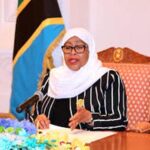
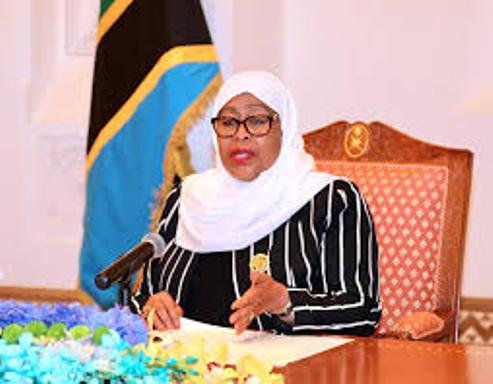
LAGOS APRIL 13TH (NEWSRANGERS)-President Samia Suluhu Hassan of Tanzania last week cancelled her planned visit to Nigeria, where she was expected to receive an honorary degree from Nasarawa State University, Karu.
The Vice-Chancellor of the university, Professor Sa’adat Hassan Liman, announced at a pre-convocation press briefing in Keffi, Nasarawa State, that President Hassan would be conferred with an honorary degree.
She also disclosed that the graduating class was drawn from 11 faculties, comprising 83 undergraduate programmes and 104 postgraduate programmes.
However, SaharaReporters learnt that President Hassan cancelled the visit amid concerns over potential embarrassment linked to alleged human rights issues in her country.
She instead opted to receive the honour virtually rather than attend in person.
The award was conferred online on Saturday, April 11, 2026, with President Samia participating in the ceremony remotely from Tanzania as Nasarawa State University, Nigeria, presented the honorary degree.
“President Hassan represents the new face of African leadership – one that balances pragmatic governance with a commitment to inclusion and international cooperation,” said a representative from Nasarawa University during the virtual ceremony as quoted by Tanzania Insight.
Since becoming Tanzania’s first female president, Hassan has been accused of human rights violations.
For example, in October 2025, Tanzanian authorities were accused of killing dozens of people during post-election protests.
The country’s main opposition party, Chadema, through its spokesperson, alleged that at least 700 people were killed in clashes with security forces, while key opposition figures were barred from contesting against President Samia Suluhu Hassan in the election.
In December 2025, Amnesty International reported that Tanzanian security forces used unnecessary and disproportionate force, including lethal means, to suppress election-related protests between 29 October and 3 November 2025, resulting in hundreds of deaths and injuries nationwide.
In its report, the human rights organisation accused the authorities of showing a “shocking disregard for the right to life and for freedom of peaceful assembly,” alleging that police and other security operatives fired live ammunition and tear gas at protesters and bystanders who posed no imminent threat.
Amnesty International further documented widespread abuses during the crackdown, including the beating of detainees, denial of medical care to the injured, removal of wounded protesters from hospitals for arrest, and the transfer of bodies from mortuaries to undisclosed locations, allegedly to conceal evidence of unlawful killings.
Amnesty International noted that its research revealed how security forces fired live rounds and tear gas at close range, often without warning, and used firearms recklessly in crowded areas, killing or injuring people who were not involved in protests.
Tear gas was also deployed abusively in residential neighbourhoods and fired into people’s homes.
The organisation said these violations took place amid a nationwide internet shutdown, which limited the flow of information and made it harder for victims and witnesses to seek help or share evidence.
Last December, concerns over academic freedom and civil liberties intensified in Tanzania following the arrest of a senior lecturer at the University of Dodoma.
University staff described the incident as an evidence of increasing state surveillance and repression under President Hassan’s administration.
According to the University of Dodoma Academic Staff Association (UDOMASA), armed police officers raided the lecturer’s residence on the night of December 9, 2025, searched his home, seized personal belongings and took him into custody.
The arrest reportedly followed comments he made during a lecture the previous day.
In a statement circulated to its members, UDOMASA alleged that the lecturer’s classroom remarks were secretly recorded by an informer planted among students and forwarded to “higher authorities,” who ordered his arrest within hours.
The lecturer was later released on bail after interrogation at a police station.
A letter titled “Urgent Alert to All Members,” dated December 12 and signed by UDOMASA General Secretary, Isaac Mahenge, warned academic staff of what the association described as a “new reality” of surveillance within university classrooms.
“On 9 December, a fellow staff member was arrested, his home searched and interrogated at a police station before he was released on bail,” the letter stated. “He was accused of allegedly making remarks in his 8 December lecture that incited students to participate in demonstrations on 9 December.”
The association said the alleged remarks were “purportedly secretly recorded by an informer in the class and sent to high authorities,” prompting swift police action.
Also in December, the United States announced a comprehensive review of its bilateral relationship with Tanzania, citing escalating repression, election-related violence, and threats to the safety of American citizens in the country.
In a statement, the Principal Deputy Spokesperson Thomas “Tommy” Pigott said the U.S. valued its partnership with the Tanzanian people but warned that recent actions by the government in Dodoma have put the decades-long relationship at risk.
According to the statement, Washington was troubled by what it described as “ongoing repression of religious freedom and free speech,” as well as persistent barriers to U.S. investment.
Saharareporters
For media advert placement, events coverage, media consultancy, placement of publications and further inquiries please WhatsApp 2348023773039 or email: labakevwe@yahoo.com